By Marc Lilly, CEO, Concierge Care Advisors
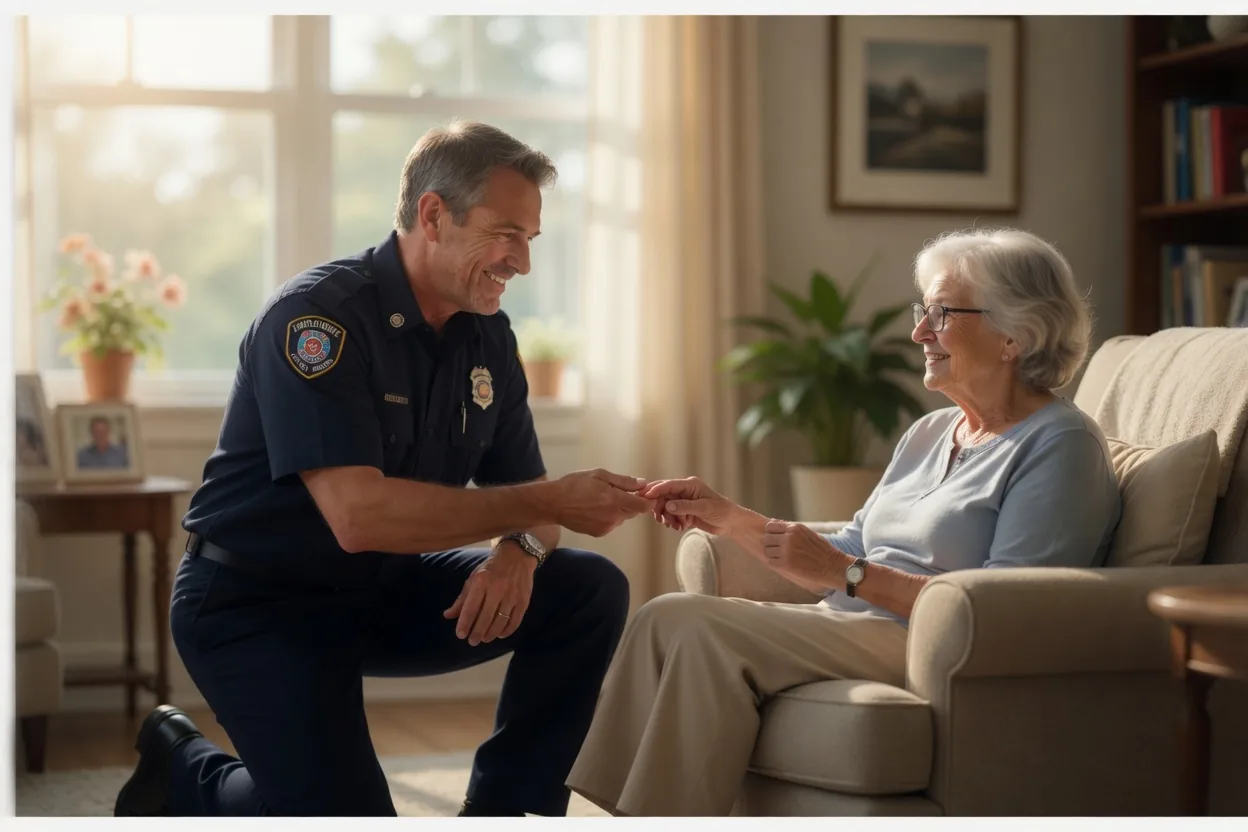
You don't think of a firefighter as a caregiver. The uniform, the truck, the sirens — none of that fits the picture most of us carry of what caregiving looks like. And yet ask any fire chief in the country what's happening on their incident reports, and you'll hear a version of the same story. A growing share of the calls coming in aren't fires, and aren't emergencies in the traditional sense. They're falls. They're welfare checks. They're a 2 a.m. call from a daughter in another state because her father wandered out and the neighbor brought him home.
Caregiving, quietly, has become part of the job.
"When a frightened spouse calls 911 because her husband doesn't recognize her anymore, a fire crew shows up. That's caregiving. We just haven't called it that — and we haven't given those crews anything to leave behind except a ride to the ER."
— Marc Lilly
Roughly 10,000 Americans turn 65 every single day. About 70% of them will need long-term care at some point, and the overwhelming majority of families will be unprepared when that moment arrives. So the question lands at a fire station. Forty percent of senior 911 calls are repeat calls to the same address — which means the issue isn't that the family had a bad day. It's that no one ever helped them build a plan, and the same crisis is running on a loop until something breaks.
Departments know this. They've known it for years. The hard part has been that there has been nothing structured, neutral, and free to leave behind when a crew clears the call — no card, no app, no name to put in a family's hand that would actually change the trajectory.
That's the gap we built Senior Navigator to close.
What we're doing with the fire service
Senior Navigator is a free care planning tool any family can use from any device. In about ten minutes it produces a personalized care recommendation — in-home, assisted living, or memory care — along with a real cost estimate based on the family's ZIP code and a financial picture that accounts for income, savings, VA benefits, and insurance coverage. If a family wants to talk to a person, a free consultation with a certified senior care advisor is one click away. No provider pays to be recommended. The clinical logic embedded in every assessment is the same logic our advisors have used with tens of thousands of families over fifteen-plus years — the same logic that informed Washington State's landmark senior placement regulation, HB 1494.
We've built a national program for fire departments around it. The mechanism is intentionally simple. Departments download print-ready QR cards, wallet cards, and station posters. Cards go in the rig. Crews hand them at welfare calls, safety visits, and community events. There's no training, no software to learn, no workflow change. The card does the work. The family does the plan.
"A repeat call to the same address isn't a failure of emergency response. It's the absence of a plan. We're trying to put the plan in the family's hands before the next call."
— Marc Lilly
What it means for a department
Every chief I've talked to has said some version of the same thing: their crews want to do more for these families than transport, and they've never had a tool that fit the moment. A QR card fits the moment. It costs the department nothing. It takes seconds at a scene. And it routes a family from the worst night of their year to a free care plan they can act on tomorrow morning.
It matters operationally too. When a department can show its city council and union leadership that it's measurably reducing repeat senior calls and strengthening community health outcomes, that's a story that travels — into budget conversations, into staffing cases, into the public's confidence in the service. Departments with strong outcomes are featured in our national network as leaders in senior community care, and we see the fire service as a natural place for that leadership to come from.
"We didn't build this for ourselves. We built it because every chief I talk to is asking the same question — what can my crews actually do for these families besides transport? Now there's an answer."
— Marc Lilly
The vision
Every fire department in America has something to hand a family in crisis. Every senior gets a care plan before the next 911 call. That's the bar.
If you lead a fire department, an EMS agency, or another first-responder organization and you want to talk about what joining the program looks like for your team, we'd welcome the conversation. The community you serve is the community we serve. Let's give your crews — and the families they meet on the worst day of their year — something better to walk away with.
— Marc Lilly
CEO, Concierge Care Advisors